Sleep Calculator: How Much Sleep Did I Get?
Actual sleep time equals Total Time in Bed minus Sleep Onset Latency (the 10–20 minutes taken to fall asleep) and Wake After Sleep Onset (WASO). An 8-hour window in bed typically yields 7 to 7.5 hours of real sleep. Healthy sleep efficiency is 85% or higher.
Ever gone to bed at night and wondered, “How much sleep did I actually get?”
It sounds like a simple question, but the answer is not always the same as the amount of time you spent in bed.
If you went to bed at 11:00 PM and got up at 7:00 AM, you had an 8-hour sleep window. But if you took 30 minutes to fall asleep or spent another 20 minutes awake during the night, your actual sleep time was less.
This is where a sleep calculator can be useful. It can help you estimate your sleep duration from your bedtime and wake-up time, compare it with your usual sleep needs, and identify patterns that may be contributing to sleep debt.
How to Calculate How Much Sleep You Got
The simplest calculation is:
Wake-up time − time you fell asleep = total sleep time
For example:
11:00 PM → 7:00 AM = 8 hours
If you went to sleep at 10:30 PM and woke up at 6:30 AM:
10:30 PM → 6:30 AM = 8 hours
But there is an important distinction between time in bed and actual sleep time.
If you got into bed at 10:30 PM but did not fall asleep until 11:00 PM, then you had 8 hours in bed but approximately 7.5 hours of sleep opportunity after falling asleep.
And if you were awake for another 30 minutes during the night, your actual sleep could be closer to 7 hours.
Use the Sleep Calculator
Our sleep calculator can help you work out the amount of time between your sleep and wake times.
For the most useful estimate, enter the time you actually fell asleep rather than simply the time you got into bed.
If you do not know exactly when you fell asleep, use your best estimate. A calculator cannot know the exact moment your brain transitioned from wakefulness to sleep without actual sleep measurements.
Example
Suppose your night looked like this:
- Got into bed: 10:30 PM
- Fell asleep: 11:00 PM
- Woke briefly during the night: 20 minutes total
- Final wake-up: 7:00 AM
You were in bed for 8.5 hours, but your estimated actual sleep was approximately:
8 hours − 20 minutes = 7 hours 40 minutes
The calculation is only an estimate, but it gives you a more realistic picture than simply counting the time between getting into bed and getting up.
How Many Hours of Sleep Did You Get?
Here are some common examples:
| Sleep time | Wake-up time | Time between |
|---|---|---|
| 9:00 PM | 5:00 AM | 8 hours |
| 10:00 PM | 6:00 AM | 8 hours |
| 11:00 PM | 7:00 AM | 8 hours |
| 12:00 AM | 8:00 AM | 8 hours |
| 1:00 AM | 9:00 AM | 8 hours |
The calculation is straightforward when you know the exact times.
The more difficult part is knowing whether that amount of sleep is enough for you.
How Much Sleep Do Adults Need?
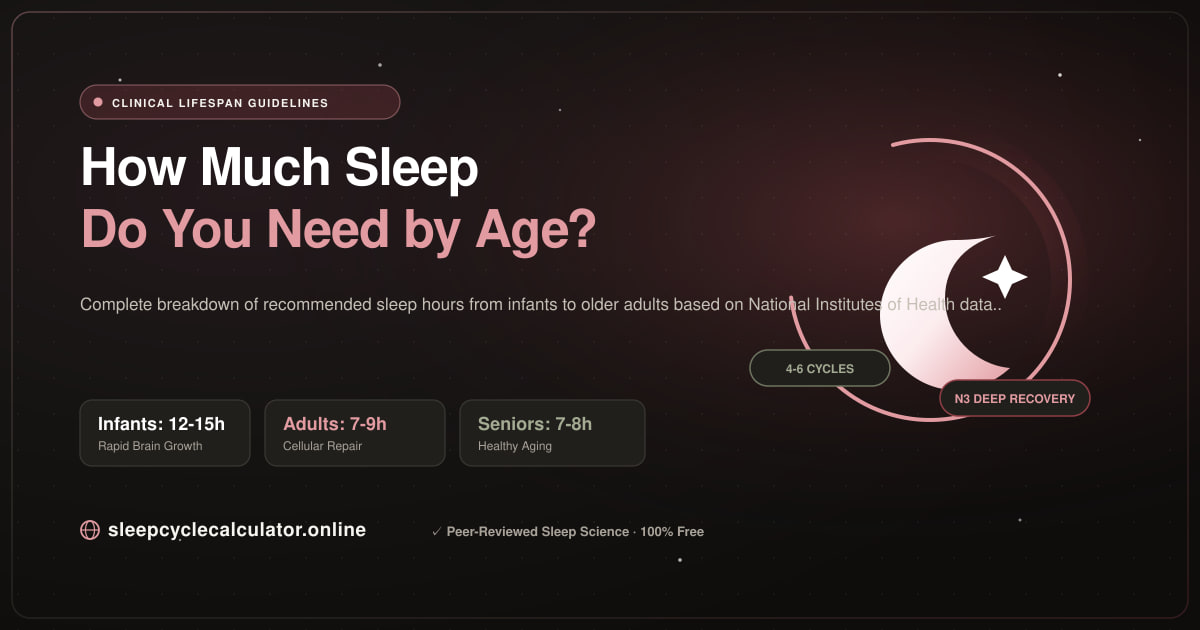
For adults, the CDC recommends at least 7 hours of sleep per day, while sleep needs can vary between individuals. Older adults may have different recommended ranges depending on age.
A practical way to think about it is:
- Less than 7 hours: may be insufficient for many adults
- Around 7–9 hours: a common healthy range for adults
- More than 9 hours: not automatically a problem, especially in certain circumstances, but persistent excessive sleep can be worth discussing with a healthcare professional
The goal is not to force yourself into one exact number. Your sleep requirement is individual.
Time in Bed vs. Actual Sleep
This is one of the most important things to understand when calculating sleep.
Imagine you:
- Get into bed: 10:00 PM
- Fall asleep: 10:30 PM
- Wake up: 6:30 AM
You spent 8.5 hours in bed, but you had only about 8 hours between falling asleep and waking.
Now imagine you were awake for another 30 minutes during the night.
Your estimated actual sleep would be around 7.5 hours.
This is why sleep researchers distinguish between different aspects of sleep rather than simply asking how long someone stayed in bed.
NHLBI's sleep diary, for example, asks people to record when they went to bed, when they woke up, how long they took to fall asleep, and how long they were awake during the night.
What If I Wake Up During the Night?
Waking briefly during the night does not necessarily mean you had a bad night's sleep.
Brief awakenings can happen naturally, including between sleep cycles.
The more useful question is whether you are awake for long periods or waking repeatedly enough to interfere with your sleep.
For example:
11:00 PM → 7:00 AM
gives you an 8-hour window.
If you briefly wake for a few minutes, you may still get close to 8 hours of sleep.
But if you spend an hour awake in the middle of the night, your actual sleep duration is considerably lower.
If this happens frequently, tracking it over several nights can reveal a pattern.
Does Falling Asleep Time Matter?
Yes.
If you get into bed at 10:00 PM but normally take 30 minutes to fall asleep, counting 10:00 PM as your sleep start will overestimate your sleep.
For a more realistic calculation, use your estimated sleep onset time.
For example:
- Bedtime: 10:00 PM
- Fell asleep: 10:30 PM
- Wake-up: 6:30 AM
Estimated sleep duration:
8 hours
Time spent in bed:
8 hours 30 minutes
That 30-minute difference matters when you are trying to understand your actual sleep pattern.
What About Naps?
If you take a nap during the day, it is useful to record it separately.
For example:
- Night sleep: 7 hours
- Afternoon nap: 30 minutes
That gives you 7.5 hours of sleep across the 24-hour period, assuming the estimates are accurate.
However, a daytime nap should not automatically be treated as an exact replacement for lost nighttime sleep. Sleep timing and quality also matter.
If you are tracking your sleep because you regularly feel tired, record your naps along with nighttime sleep. NHLBI's sleep diary specifically includes nap times and lengths.
How Much Sleep Did I Get If I Went to Bed After Midnight?
Crossing midnight can make manual calculations confusing.
For example:
11:30 PM → 6:30 AM = 7 hours
But:
12:30 AM → 7:30 AM = 7 hours
And:
11:00 PM → 7:00 AM = 8 hours
The fact that the date changes at midnight does not change the calculation. You simply need to account for the time from bedtime through midnight and then add the time after midnight.
A calculator can handle this automatically.
How Much Sleep Did I Get If I Went to Bed at 11 PM?
If you fell asleep at 11:00 PM, your sleep duration depends entirely on when you woke up.
Examples:
- 5:00 AM → 6 hours
- 6:00 AM → 7 hours
- 7:00 AM → 8 hours
- 8:00 AM → 9 hours
- 9:00 AM → 10 hours
If you got into bed at 11:00 PM but did not fall asleep until 11:30 PM, subtract that time when estimating actual sleep.
How Much Sleep Did I Get If I Went to Bed at 10 PM?
If you fell asleep at 10:00 PM:
- 5:00 AM → 7 hours
- 6:00 AM → 8 hours
- 7:00 AM → 9 hours
- 8:00 AM → 10 hours
Again, these calculations assume you were asleep for the entire period.
How Much Sleep Did I Get If I Went to Bed at 12 AM?
If you fell asleep at midnight:
- 6:00 AM → 6 hours
- 7:00 AM → 7 hours
- 8:00 AM → 8 hours
- 9:00 AM → 9 hours
If you regularly sleep at midnight but must wake at 6:00 AM, you only have a six-hour sleep window. That may be less than the amount of sleep many adults need.
How Sleep Debt Fits Into the Calculation
A single night tells you how much sleep you got that night.
Looking at several nights tells you much more.
Suppose you usually aim for 8 hours but sleep:
- Monday: 6 hours
- Tuesday: 7 hours
- Wednesday: 6.5 hours
- Thursday: 7 hours
- Friday: 6 hours
You have repeatedly fallen short of your target.
This accumulated shortfall is commonly referred to as sleep debt.
However, sleep debt should not be treated as a perfectly precise bank account where every missed minute has to be repaid minute-for-minute. Sleep and recovery are more complicated than that.
The useful takeaway is that repeated insufficient sleep matters more than one isolated short night.
Can a Sleep Calculator Tell Me If My Sleep Was Good?
Not by itself.
A calculator can estimate how long you slept.
It cannot determine everything about sleep quality.
Two people could both sleep for eight hours but have very different nights. One might sleep continuously, while the other might wake frequently.
Sleep quality can also be affected by factors such as:
- Frequent awakenings
- Difficulty falling asleep
- An irregular sleep schedule
- Environmental disturbances
- Stress
- Certain medications or substances
- Sleep disorders
So think of sleep duration as one important piece of the picture—not the entire picture.
What About Sleep Cycles?
Sleep is not simply one continuous state.
During the night, you move through NREM and REM sleep in repeating cycles (learn more in our guide on what happens during a night of sleep). A typical cycle restarts roughly every 80–100 minutes, and people generally experience around four to six cycles per night.
But this does not mean you can calculate your exact sleep duration or sleep quality by multiplying 90 minutes by a number of cycles.
Sleep-cycle length varies, and the distribution of sleep stages changes throughout the night.
For that reason, if your goal is to answer “How much sleep did I get?”, calculate your actual sleep duration first. Use our 90-minute sleep cycle calculator as a planning tool rather than a precise measurement of what happened inside your brain.
Does 8 Hours in Bed Mean 8 Hours of Sleep?
No.
Eight hours in bed can result in less than eight hours of actual sleep.
For example:
- 10:00 PM: get into bed
- 10:30 PM: fall asleep
- 2:00 AM: wake for 20 minutes
- 6:30 AM: wake for the day
Your total time in bed is 8.5 hours.
Your estimated sleep is approximately:
8 hours 30 minutes − 30 minutes before sleep − 20 minutes awake = 7 hours 40 minutes
This is an estimate, but it demonstrates why the two measurements are different.
How to Track Your Sleep More Accurately
If you want to understand your sleep over time, do not rely on one night's calculation.
Keep a simple sleep record for a couple of weeks.
Record:
- Time you went to bed
- Estimated time you fell asleep
- Number and length of nighttime awakenings
- Final wake-up time
- Morning naps or daytime naps
- How rested you felt after waking
- How sleepy you felt during the day
- Caffeine intake and timing
NHLBI provides a sleep diary designed to record sleep quantity and quality along with factors such as caffeine, alcohol, medicines, naps, and daytime sleepiness.
Patterns are often more useful than a single number.
What If I Sleep 8 Hours but Still Feel Tired?
Getting eight hours does not guarantee that you will feel completely refreshed.
You might still feel tired because:
- Your sleep was interrupted
- Your sleep schedule is irregular
- You have accumulated sleep loss from previous days
- Your sleep quality was poor
- You woke during a period of sleep inertia
- Stress or other factors affected your sleep
- You may have an underlying sleep problem
If you consistently have enough opportunity to sleep but still feel excessively sleepy or unrefreshed, it is worth discussing the issue with a healthcare professional. NHLBI notes that sleep diaries can also help doctors understand patterns of falling asleep, staying asleep, and daytime sleepiness.
How Much Sleep Should You Aim For Tonight?
Rather than trying to find a magic number of hours, start with your age and individual needs.
For adults, current CDC guidance recommends at least 7 hours per day, with specific recommendations varying by age group.
If you know you function well with around 8 hours, build your schedule around that rather than repeatedly aiming for the minimum.
For example, if you need to wake at 6:00 AM and want approximately 8 hours of sleep, you would want to be asleep around 10:00 PM.
If you normally take 30 minutes to fall asleep, getting into bed around 9:30 PM may make more sense.
Sleep Duration Examples
Here are some quick examples of how much sleep you get based on the time you fall asleep and wake up:
- 9 PM to 5 AM — 8 hours
- 10 PM to 6 AM — 8 hours
- 11 PM to 6 AM — 7 hours
- 11 PM to 7 AM — 8 hours
- 12 AM to 7 AM — 7 hours
- 12 AM to 8 AM — 8 hours
- 1 AM to 7 AM — 6 hours
These examples assume you fall asleep immediately and remain asleep until waking. Your actual sleep may be shorter if you take time to fall asleep or spend time awake during the night.
Frequently Asked Questions
How do I calculate how much sleep I got?
Calculate the time between when you actually fell asleep and when you finally woke up, then account for significant periods when you were awake during the night.
How many hours did I sleep if I slept from 11 PM to 7 AM?
If you were asleep continuously from 11 PM to 7 AM, you got 8 hours of sleep.
Is 7 hours of sleep enough?
Seven hours is the minimum recommended amount for many adults, but individual sleep needs vary. Some adults need more to feel and function well.
Is 8 hours of sleep enough?
Eight hours is within a commonly recommended amount for adults and may be appropriate for many people. Your individual needs and how you feel and function are also relevant.
Does time in bed count as sleep?
Not necessarily. Time in bed includes the time spent trying to fall asleep and any periods when you are awake during the night.
How much sleep did I get if I was awake for an hour?
Subtract the hour you were awake from the period between falling asleep and your final wake-up time to estimate your actual sleep.
Do naps count toward total sleep?
Yes, naps are sleep and can be included when looking at total sleep across a 24-hour period. However, a nap does not necessarily provide the same role as a full nighttime sleep period.
Can a sleep calculator measure my actual sleep?
No. A calculator can calculate or estimate sleep duration from the times you provide. It cannot directly measure your brain activity or determine your exact sleep stages.
Can my smartwatch tell me exactly how much I slept?
Wearables can estimate sleep using sensors and algorithms, but they do not directly measure sleep in the same way as a clinical sleep study. Treat their results as estimates rather than exact measurements.
Why do I get different sleep results from different calculators?
Different calculators may make different assumptions about falling-asleep time, wake time, naps, awakenings, or sleep-cycle length. Check what the calculator is actually measuring before comparing results.
Should I count sleep cycles or sleep hours?
For understanding how much sleep you actually got, sleep duration is the more direct measurement. Sleep cycles are useful for understanding sleep architecture and planning, but they are not fixed 90-minute blocks.
A sleep calculator can answer a surprisingly useful question: “How much sleep did I actually get?”
Start with the time you fell asleep and the time you woke up. Then account for meaningful periods of wakefulness during the night and any naps if you are looking at your total sleep across the day.
Remember that time in bed is not always the same as actual sleep.
And if you want to understand your sleep properly, do not judge everything from one night. Track your sleep for several days or weeks and look for patterns in sleep duration, consistency, awakenings, and how rested you feel.
For a quick estimate, enter your sleep and wake times into the Sleep Calculator and use the result as a practical starting point for building a healthier sleep schedule, or browse our complete library of evidence-based sleep articles.
Scientific Sources & Clinical Guidelines
- Reed, D. L., & Sacco, W. P. (2016). Measuring Sleep Efficiency: What Does It Mean? Journal of Clinical Sleep Medicine, 12(7), 1053–1066.
- American Academy of Sleep Medicine. (2014). International Classification of Sleep Disorders, 3rd ed. Darien, IL: American Academy of Sleep Medicine.
- Carney, C. E., Buysse, D. J., et al. (2012). The consensus sleep diary: standardizing prospective sleep self-monitoring. Sleep, 35(2), 287–302.